AI in TPLO Planning: What It Can Do Today
Quick answer
Partly. AI can detect the tibial landmarks and measure the tibial plateau angle close to a surgeon on most radiographs: in osAlign's own validation on 169 held-out patients, the median TPA difference was 2.5°. The right use today is surgeon-verified decision support: AI places, the surgeon confirms, and the software does the geometry.
Key takeaways
- AI landmark detection removes the slowest, most repetitive part of planning: clicking every point.
- osAlign validated its production model on 193 radiographs from 169 patients it never trained on: median TPA difference 2.5°, 78% within 5°, no systematic bias.
- A 2026 research study reported a mean absolute TPA error of 1.34°, with 82% of cases within 2° of the surgeon reference.
- Researchers, and osAlign, position AI as decision support the surgeon verifies, not autonomous planning.
- In osAlign today, AI places the four TPA landmarks for you to confirm; more AI features roll out across Q4 2026 into 2027.
What AI does in TPLO planning today
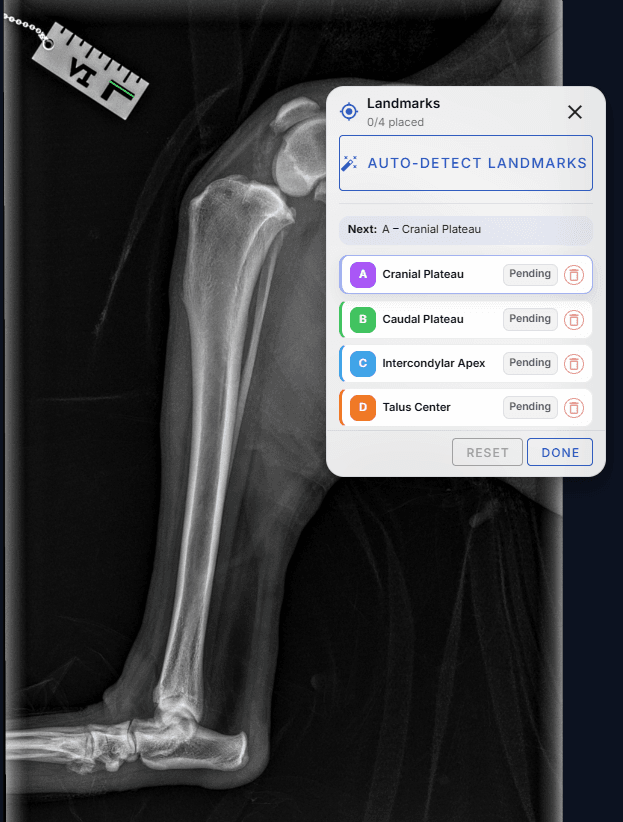
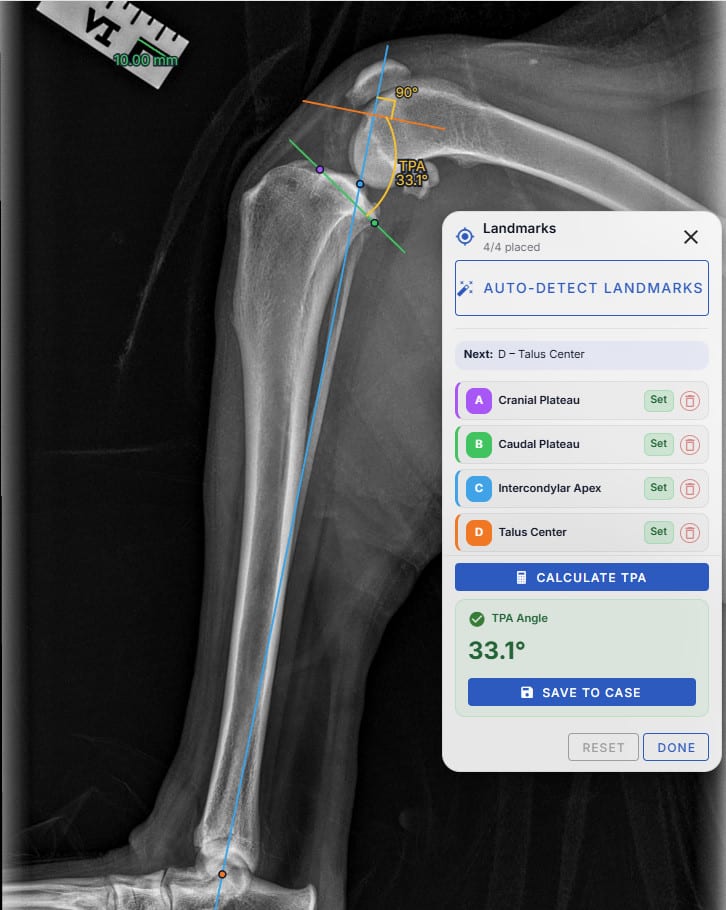
Most of TPLO planning is geometry that follows from a few anatomical points. Once the cranial and caudal plateau margins, the intercondylar eminence, and the talus center are placed, the tibial plateau angle is pure calculation. The hard, slow, variable part is placing those points. That is the part AI is good at.
- Landmark detection: a neural network finds the tibial landmarks on the lateral radiograph.
- Automatic TPA: the software calculates the angle from those landmarks instantly.
- Consistency: the model places points the same way every time, which reduces the case-to-case drift seen with manual placement.
What the research says
A 2026 study in the journal Animals trained a U-Net landmark detector with a geometric module to measure TPA and suggest saw blade size. On 200 radiographs from 130 dogs it reported a mean absolute TPA error of 1.34° against the surgeon reference, with 82% of cases within 2°. The authors concluded such systems should be positioned as surgeon-verified decision support rather than autonomous planning.
Earlier work (2021) had already shown that deep learning could detect TPA landmarks on canine radiographs. For context, studies of manual measurement have found differences of a few degrees between and within human observers, so a model that is consistently within 1 to 2° is in a clinically meaningful range.
We ran the same kind of test on osAlign's own model. The results are in the next section.
osAlign's own validation results
We tested the landmark model that runs in osAlign today against landmarks placed by surgeons on lateral pre-operative radiographs. Every test radiograph came from a patient the model never saw in training: each of the four networks in the pipeline was trained on the same patient-level split, and we tested only on patients held out from all four. TPA was calculated from both sets of landmarks exactly as the osAlign planner calculates it.
| Measure | Result |
|---|---|
| Radiographs (patients) | 193 (169) |
| Median TPA difference, AI vs surgeon | 2.5° |
| Mean absolute TPA difference | 3.4° |
| Average bias (AI minus surgeon) | +0.2° |
| Within 2° of the surgeon | 40% |
| Within 3° | 58% |
| Within 5° | 78% |
| 90% of cases within | 6.2° |
What this means. On a typical radiograph the AI lands within a few degrees of the surgeon, with no tendency to read high or low, which is why it saves most of the clicking. But roughly one case in five is more than 5° off and a small number are far off. That is exactly why osAlign shows every AI-placed landmark for the surgeon to confirm or drag before the TPA is used.
How it compares. The 2026 research model above reported a 1.34° mean error with 82% of cases within 2°. osAlign's current model is not there yet on that measure. Closing the gap is the focus of the AI work rolling out across Q4 2026 into 2027, and we will update these numbers on this page as new models ship.
Limitations: this is a retrospective test against one set of reference annotations, not a prospective clinical study, and it measures agreement with surgeons rather than surgical outcomes.
Why the surgeon still confirms every plan
- Outliers exist. Even a model within 2° on 82% of cases is outside that on the rest: unusual anatomy, heavy osteophytes, poor positioning, implants from previous surgery.
- Garbage in, garbage out. A rotated radiograph or a missing talus produces a wrong TPA whether a human or a model places the points.
- Clinical judgment is not geometry. Target angle, handling an excessive TPA, meniscal status and patient factors are decisions for the surgeon.
That is how osAlign is built: AI places, you confirm. Every landmark can be dragged, every angle recalculates live, and nothing is saved to the case until you accept it.
Where AI TPLO planning is going
osAlign's AI features are rolling out across Q4 2026 into 2027, building toward the full agentic release:
- AI that completes the whole preplan (calibration, landmarks, TPA, osteotomy and rotation, and plate selection) for you to review
- X-ray acquisition station integration, so radiographs flow straight into planning with no exports or uploads
- Automatic surgical reports (recommended plate, TPA, rotation, and D1, D2, D3 measurements) delivered to the surgeon within seconds of the radiograph being taken
Questions to ask any AI planning tool
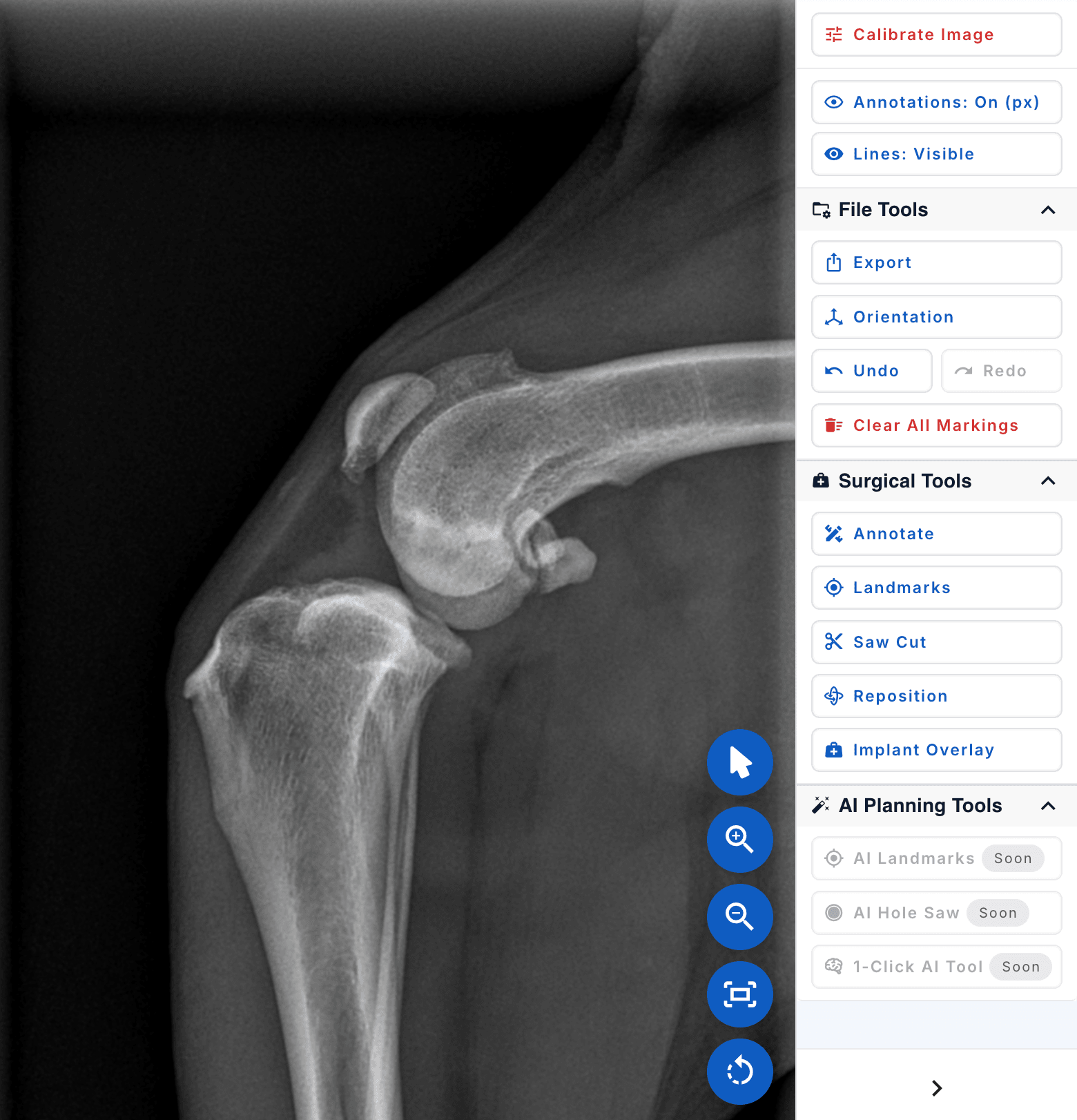
- Can I see and move every landmark the AI placed?
- Does it calibrate against a marker, or only trust DICOM pixel spacing?
- Does it show the geometry (axis, perpendicular, plateau line), or only a number?
- Does the rotation preview show the resulting angle on the image?
- Are the plate templates true size, from real plates?
- What validation data has the vendor published?
Frequently asked questions
Can AI plan a TPLO?
AI can already detect the tibial landmarks and measure the TPA close to surgeon accuracy on most radiographs. The recommended approach is surgeon-verified decision support: the AI places and calculates, and the surgeon reviews and confirms.
How accurate is AI at measuring the tibial plateau angle?
A 2026 study reported a mean absolute error of 1.34° against the surgeon reference on 200 radiographs, with 82% of measurements within 2°.
How accurate is osAlign's AI?
On 193 radiographs from 169 patients the model never trained on, osAlign's AI measured the TPA with a median difference of 2.5° from surgeons (mean 3.4°), with 78% of cases within 5° and no systematic bias. The surgeon confirms every AI-placed landmark before it is used.
What does osAlign's AI do today?
osAlign's AI places the four TPA landmarks (cranial and caudal plateau, intercondylar apex, talus center) for you to confirm, and the TPA is calculated automatically. With the rest of the tools, a case takes under 60 seconds.
When will fully automatic TPLO planning be available?
osAlign's AI features are rolling out across Q4 2026 into 2027, building toward the full agentic release that connects to the X-ray acquisition station and delivers a ready-to-review surgical report.
References
- Deep learning-based automated anatomical landmark detection and saw blade size prediction for canine TPLO. Animals (MDPI), 2026. https://pmc.ncbi.nlm.nih.gov/articles/PMC13255856/
- Auto detection of tibial plateau angle in canine radiographs using a deep learning approach. arXiv, 2021. https://arxiv.org/pdf/2102.12544
- Fettig AA, Rand WM, Sato AF, et al. Observer variability of tibial plateau slope measurement in 40 dogs with cruciate ligament-deficient stifle joints. Vet Surg. 2003;32(5):471-478. https://pubmed.ncbi.nlm.nih.gov/14569576/
For educational and planning support only. Surgeon judgment governs all clinical decisions.
Related guides
Plan your next TPLO in under 60 seconds
AI places the landmarks, the TPA is calculated instantly, and every measurement is reported to 0.1 mm. 30-day free trial with up to 5 cases, no credit card required.
Start free trial