TPLO Rotation and Saw Blade Selection
Quick answer
Choose the TPLO saw blade whose radius fits the proximal tibia with the cut centered near the intercondylar eminence and enough tibial tuberosity left in front. Then rotation distance along the cut is 2π × blade radius × (TPA − target angle) ÷ 360. For a 25° TPA, a 5° target, and an 18 mm blade, that is about 6.3 mm.
Key takeaways
- TPLO blades are sized by radius; the right one fits the proximal tibia and preserves tibial tuberosity width.
- Centering the osteotomy near the intercondylar eminence minimizes residual cranial tibial subluxation.
- Rotation distance = 2π × radius × correction angle ÷ 360; bigger blades need more millimeters per degree.
- The formula is an approximation; osAlign simulates the rotation on the image and reports the resulting slope and arc directly.
TPLO saw blades are sized by radius
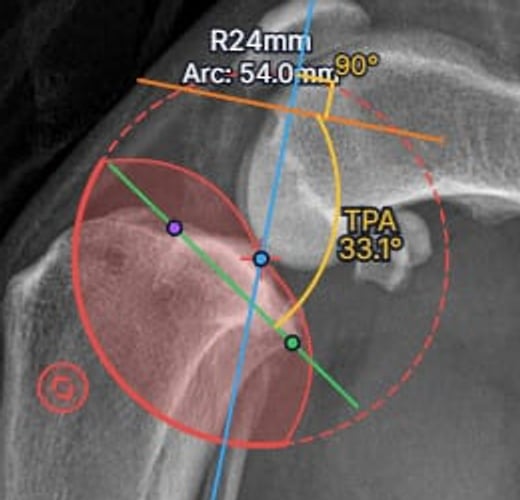
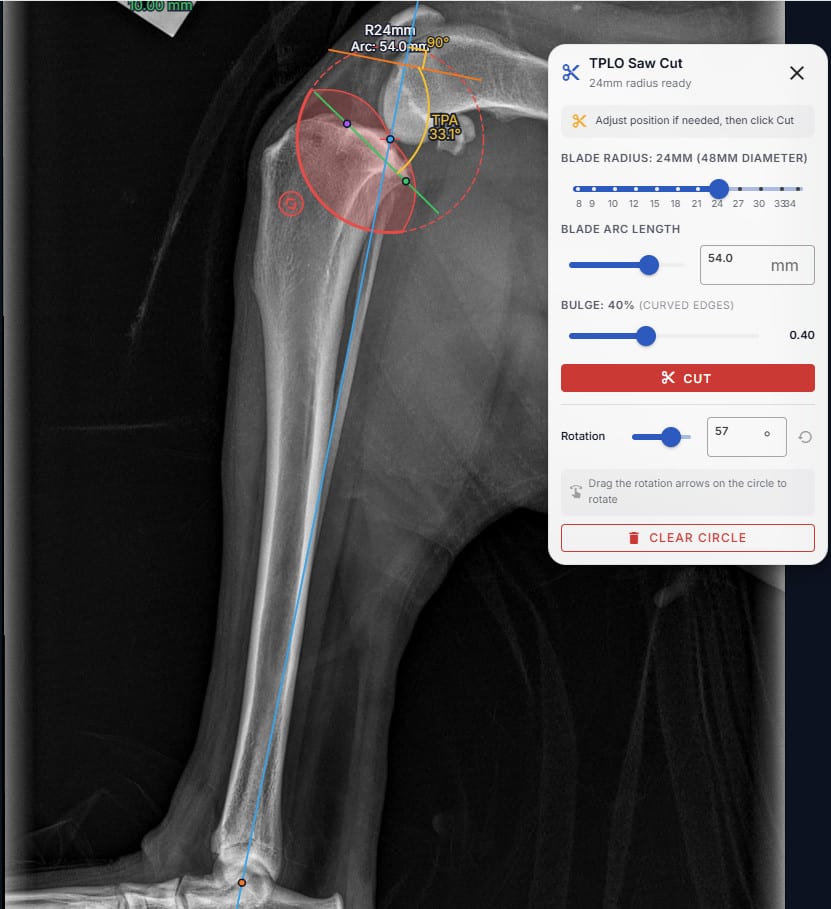
A TPLO saw blade is a curved (biradial) blade that cuts an arc. Blades are described by radius, commonly from about 8 mm for toy breeds to 30 mm and above for giant breeds. osAlign offers blade radii of 8, 9, 10, 12, 15, 18, 21, 24, 27, 30, 33, and 34 mm and draws each one at true size on the calibrated radiograph.
How to choose the blade and position the cut
- Center the cut near the intercondylar eminence. Kowaleski and colleagues found that a centered osteotomy minimized residual cranial tibial subluxation compared with a distally placed one.
- Keep the proximal segment large enough to hold the proximal plate screws without entering the joint.
- Preserve tibial tuberosity width. A cut that leaves a thin tuberosity in front of it raises the risk of tuberosity fracture; Collins and colleagues identified lack of osteotomy planning and decreased tibial crest width as risk factors.
- Exit the caudal cortex sensibly, perpendicular enough to the cortex that the segment rotates cleanly.
In practice, try the blade sizes on the image and pick the one that satisfies all four. On a calibrated radiograph that takes seconds; on film it means trying several acetate templates.
The rotation formula
Rotation distance (mm) = 2π × blade radius (mm) × (TPA − target angle) ÷ 360
The arc length along the osteotomy corresponding to the correction angle.
Worked example. TPA 25°, target 5°, 18 mm blade: correction = 20°; 2π × 18 = 113.1 mm (the full circumference); 113.1 × 20 ÷ 360 = 6.3 mm. In surgery you mark reference points on either side of the cut and rotate the plateau segment until they are 6.3 mm apart along the osteotomy.
TPLO rotation table
| Blade radius | 10° correction | 15° | 20° | 25° | 30° |
|---|---|---|---|---|---|
| 12 mm | 2.1 mm | 3.1 mm | 4.2 mm | 5.2 mm | 6.3 mm |
| 15 mm | 2.6 mm | 3.9 mm | 5.2 mm | 6.5 mm | 7.9 mm |
| 18 mm | 3.1 mm | 4.7 mm | 6.3 mm | 7.9 mm | 9.4 mm |
| 21 mm | 3.7 mm | 5.5 mm | 7.3 mm | 9.2 mm | 11.0 mm |
| 24 mm | 4.2 mm | 6.3 mm | 8.4 mm | 10.5 mm | 12.6 mm |
| 27 mm | 4.7 mm | 7.1 mm | 9.4 mm | 11.8 mm | 14.1 mm |
| 30 mm | 5.2 mm | 7.9 mm | 10.5 mm | 13.1 mm | 15.7 mm |
Why simulate the rotation instead of using a chart
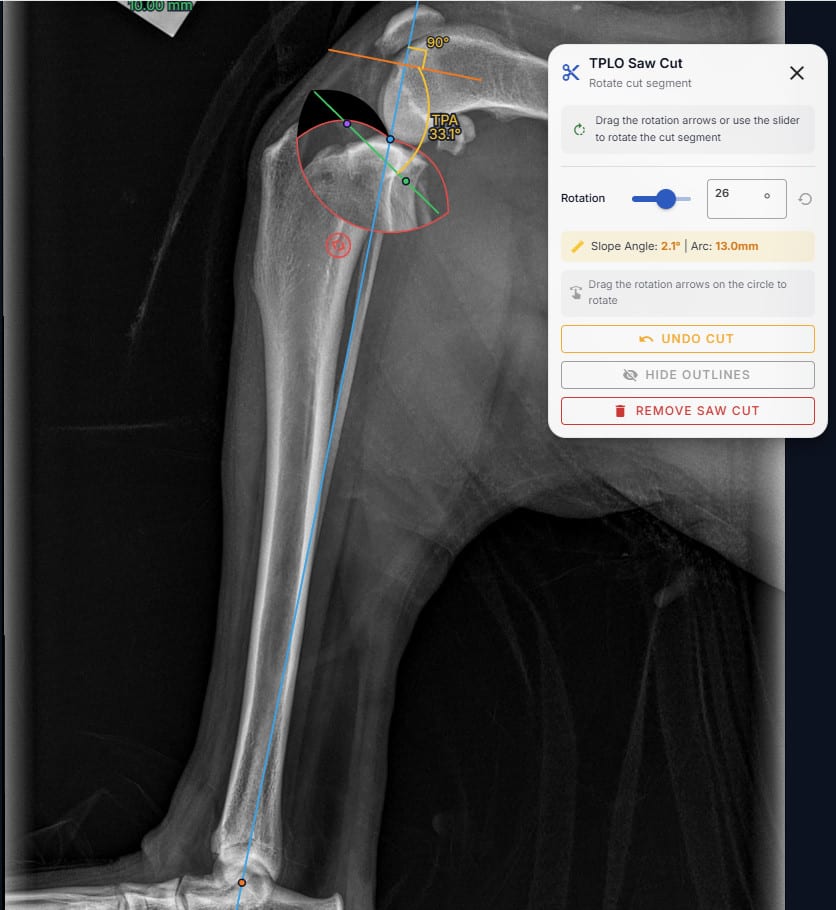
The formula assumes the plateau angle drops by exactly the angle you rotate. But the rotated segment carries the intercondylar eminence, the proximal end of the functional axis, so the axis itself shifts as the segment moves, and the final TPA can differ from simple subtraction depending on where the osteotomy is centered.
osAlign handles this by doing the rotation on the image. Cut the segment, rotate it with the slider or the on-image arrows, and the panel reports the resulting slope angle and the arc distance in real time. One click rotates to your saved target angle. For why the numbers are reported to 0.1 mm, see planning a TPLO to 0.1 mm precision.
Frequently asked questions
How do you calculate TPLO rotation?
Rotation distance in mm = 2π × saw blade radius × (TPA − target angle) ÷ 360. For a 25° TPA, a 5° target, and an 18 mm blade, that is about 6.3 mm along the osteotomy.
What size saw blade should I use for a TPLO?
Choose the blade radius that fits the proximal tibia with the osteotomy centered near the intercondylar eminence, a proximal segment large enough for the plate screws, and adequate tibial tuberosity width in front of the cut. Trying sizes on a calibrated radiograph is the fastest way to decide.
Do I need a TPLO rotation chart?
Not if you plan digitally. Charts are pre-computed versions of the rotation formula. osAlign calculates rotation for your exact blade and TPA and also simulates the rotation on the image to show the resulting slope.
References
- Kim SE, Pozzi A, Kowaleski MP, Lewis DD. Tibial osteotomies for cranial cruciate ligament insufficiency in dogs. Vet Surg. 2008;37(2):111-125. https://pubmed.ncbi.nlm.nih.gov/18251804/
- Collins JE, Degner DA, Hauptman JG, DeCamp CE. Benefits of pre- and intraoperative planning for tibial plateau leveling osteotomy. Vet Surg. 2014;43(2):142-149. https://pubmed.ncbi.nlm.nih.gov/24491234/
- Fox DB. TPLO principles, patient selection, and preoperative planning (rotation distance formula).
- Kowaleski MP, Apelt D, Mattoon JS, Litsky AS. The effect of tibial plateau leveling osteotomy position on cranial tibial subluxation: an in vitro study. Vet Surg. 2005;34(4):332-336. https://pubmed.ncbi.nlm.nih.gov/16212587/
- Slocum B, Slocum TD. Tibial plateau leveling osteotomy for repair of cranial cruciate ligament rupture in the canine. Vet Clin North Am Small Anim Pract. 1993;23(4):777-795. https://pubmed.ncbi.nlm.nih.gov/8337790/
For educational and planning support only. Surgeon judgment governs all clinical decisions.
Related guides
Plan your next TPLO in under 60 seconds
AI places the landmarks, the TPA is calculated instantly, and every measurement is reported to 0.1 mm. 30-day free trial with up to 5 cases, no credit card required.
Start free trial