Tibial Plateau Angle (TPA): What It Is and How to Measure It
Quick answer
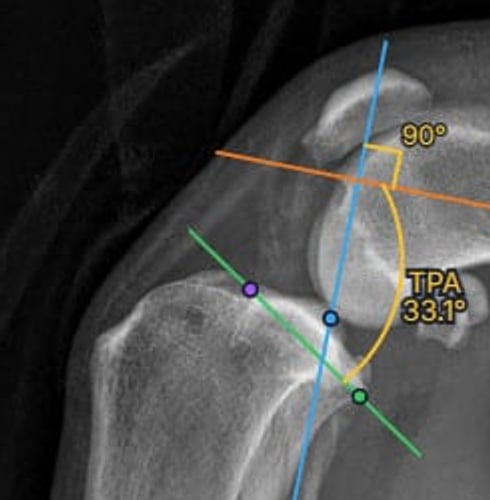
The tibial plateau angle (TPA) is the angle between the canine tibial plateau and a line perpendicular to the tibia's functional axis, measured on a lateral radiograph. It quantifies how steeply the plateau slopes backward. In TPLO surgery the plateau is rotated to reduce that angle to a target of about 5°.
Key takeaways
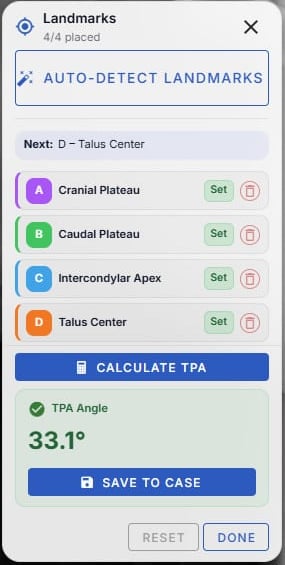
- TPA uses four landmarks: the cranial and caudal plateau margins, the intercondylar eminence, and the center of the talus.
- The functional axis runs from the intercondylar eminence to the talus; TPA is measured from the perpendicular to that axis.
- Most dogs fall roughly in the high teens to high 20s, with wide individual and breed variation; there is no single "normal" value.
- Positioning and landmark placement are the main sources of error, so a true lateral view matters as much as the software.
What the TPA measures
The canine tibial plateau slopes caudally. During weight bearing, that slope turns part of the joint's compressive force into cranial tibial thrust, the forward shear force normally resisted by the cranial cruciate ligament. The TPA puts a number on the slope, which is why it is the starting point of every TPLO plan.
The four landmarks
| Landmark | Where it goes | What it defines |
|---|---|---|
| A: Cranial plateau | The most cranial point of the medial tibial plateau | Front end of the plateau line |
| B: Caudal plateau | The most caudal point of the medial tibial plateau | Back end of the plateau line |
| C: Intercondylar apex | Midpoint between the intercondylar eminences (tubercles) | Proximal end of the functional axis |
| D: Talus center | Center of the talus | Distal end of the functional axis |
How to measure the TPA
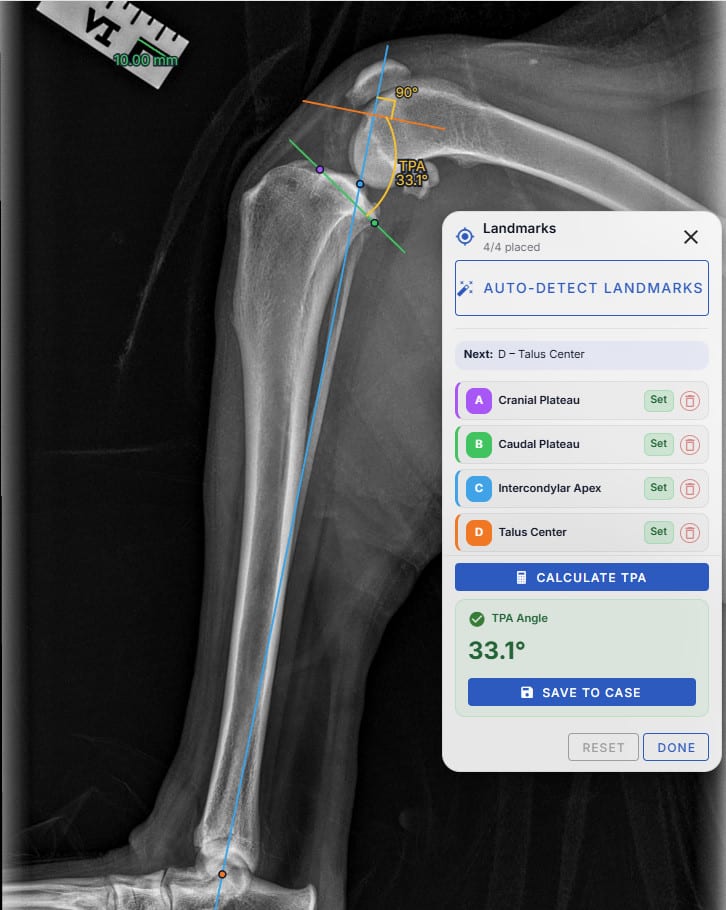
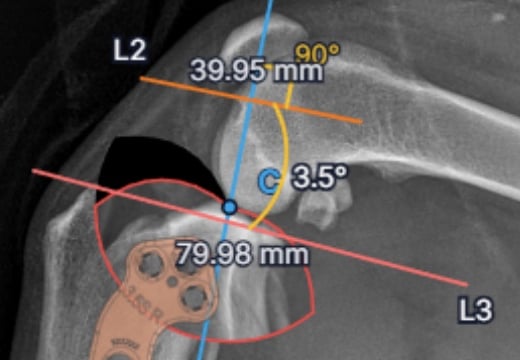
- Draw the functional axis from the intercondylar eminence (C) to the center of the talus (D).
- Draw a line perpendicular to the functional axis at the plateau.
- Draw the plateau line from the cranial (A) to the caudal (B) margin of the medial plateau.
- The TPA is the angle between the plateau line and the perpendicular.
In osAlign you place (or confirm AI-placed) points A to D and the software draws the axis, the 90° reference, and the angle arc, and reports the TPA to 0.1°.
What is a normal TPA in dogs?
There is no single normal value. Published series of dogs with and without cruciate disease mostly report mean TPAs in the low to mid 20s, with individual dogs ranging from the teens to well over 30°. Breed matters: Su and colleagues compared small and large breed dogs and found that small breeds tend to have higher TPAs. Reif and Probst found no meaningful difference between normal and cruciate-deficient stifles in Labrador retrievers, which is one reason TPA alone does not predict who will rupture a ligament.
Definitions of an "excessive" TPA vary between authors, commonly somewhere above 30° to 35°. In those dogs some surgeons modify the plan, for example by combining TPLO with a cranial closing wedge ostectomy, because a very large rotation moves the tibial tuberosity and the joint surface considerably.
Target post-op TPA
Most surgeons level the plateau to around 5°. The rationale comes from Warzee and colleagues' in vitro study, in which leveling to about 6.5° neutralized cranial tibial thrust. osAlign defaults to a 5° target, lets each surgeon save a preferred target, and shows the resulting slope as you rotate the segment.
Where TPA measurements go wrong
- Rotated or oblique radiographs. If the femoral condyles do not superimpose, the plateau margins shift and the angle changes. In a cadaver study, Reif and colleagues showed that moving the limb away from the center of the X-ray beam changed the measured TPA by up to 3.6° (5.7° with a tangent-based method): cranial and proximal positioning overestimated it, caudal and distal positioning underestimated it, and a true lateral view matched the anatomic TPA.
- Missing talus. Without the talus the functional axis is guessed, which directly changes the TPA.
- Landmark choice. Picking the plateau margins is subjective, especially with osteophytes. Studies of observer variability (for example Fettig and colleagues) found differences of a few degrees between and within observers.
- Rounding. Chart lookups and rounding to whole degrees add error before surgery starts.
Frequently asked questions
What is the tibial plateau angle?
The tibial plateau angle (TPA) is the angle between the tibial plateau and a line perpendicular to the tibial functional axis on a lateral radiograph. It measures how steeply the plateau slopes caudally.
What landmarks are used to measure TPA?
Four: the cranial and caudal margins of the medial tibial plateau, the intercondylar eminence (the proximal end of the functional axis), and the center of the talus (the distal end).
What is a normal TPA in a dog?
There is no single normal value. Most published means fall in the low to mid 20s, with wide individual and breed variation; small breeds tend to have higher TPAs.
What TPA do you aim for after TPLO?
Most surgeons target about 5°, based on in vitro evidence that leveling the plateau to around 6.5° neutralizes cranial tibial thrust.
How does osAlign calculate the TPA?
Once the four landmarks are placed, by you or by osAlign's AI for you to confirm, osAlign draws the functional axis and its perpendicular and reports the TPA to 0.1° immediately.
References
- Reif U, Dejardin LM, Probst CW, DeCamp CE, Flo GL, Johnson AL. Influence of limb positioning and measurement method on the magnitude of the tibial plateau angle. Vet Surg. 2004;33(4):368-375. https://pubmed.ncbi.nlm.nih.gov/15230840/
- Slocum B, Slocum TD. Tibial plateau leveling osteotomy for repair of cranial cruciate ligament rupture in the canine. Vet Clin North Am Small Anim Pract. 1993;23(4):777-795. https://pubmed.ncbi.nlm.nih.gov/8337790/
- Warzee CC, Dejardin LM, Arnoczky SP, Perry RL. Effect of tibial plateau leveling on cranial and caudal tibial thrusts in canine cranial cruciate-deficient stifles: an in vitro experimental study. Vet Surg. 2001;30(3):278-286. https://pubmed.ncbi.nlm.nih.gov/11340560/
- Reif U, Probst CW. Comparison of tibial plateau angles in normal and cranial cruciate deficient stifles of Labrador retrievers. Vet Surg. 2003;32(4):385-389. https://pubmed.ncbi.nlm.nih.gov/12866002/
- Fettig AA, Rand WM, Sato AF, et al. Observer variability of tibial plateau slope measurement in 40 dogs with cruciate ligament-deficient stifle joints. Vet Surg. 2003;32(5):471-478. https://pubmed.ncbi.nlm.nih.gov/14569576/
- Su L, Townsend KL, Au J, Wittum TE. Comparison of tibial plateau angles in small and large breed dogs. Can Vet J. 2015;56(6):610-614. https://pubmed.ncbi.nlm.nih.gov/26028684/
- IMAIOS vet-Anatomy: tibial plateau angle. https://www.imaios.com/en/vet-anatomy/anatomical-structures/tibial-plateau-angle-11111647524
For educational and planning support only. Surgeon judgment governs all clinical decisions.
Related guides
Plan your next TPLO in under 60 seconds
AI places the landmarks, the TPA is calculated instantly, and every measurement is reported to 0.1 mm. 30-day free trial with up to 5 cases, no credit card required.
Start free trial