Planning a TPLO to 0.1 mm Precision
Quick answer
osAlign plans a TPLO to 0.1 mm by calibrating the radiograph against a physical marker, then computing every length and angle from that calibration: 0.1 mm for the saw cut arc and rotation, 0.1° for the TPA and post-rotation slope. Real-world accuracy still depends on positioning and calibration, so the plan shows its geometry, not just numbers.
Key takeaways
- Precision starts at calibration: a line across a known distance on a marker at the level of the bone.
- osAlign reports angles to 0.1° and lengths to 0.1 mm, with no chart lookups or whole-degree rounding.
- Rotation is simulated on the image, so the resulting slope is measured directly, not estimated.
- Precision is not accuracy: positioning, magnification, and landmark choice decide how close the plan is to the real bone.
Why millimeters matter in a TPLO
TPLO corrections are small. With an 18 mm blade, each degree of correction is only about 0.3 mm of rotation along the osteotomy (2π × 18 ÷ 360 ≈ 0.31 mm). A 1 mm error in rotation is about 3° of plateau angle. Estimating from a printed chart, or rounding to the nearest millimeter, can easily move the result several degrees from the target.
mm of rotation per degree = 2π × blade radius ÷ 360
12 mm blade ≈ 0.21 mm/°; 18 mm ≈ 0.31 mm/°; 24 mm ≈ 0.42 mm/°; 30 mm ≈ 0.52 mm/°.
That is why osAlign resolves lengths to 0.1 mm and angles to 0.1°: at those resolutions, rounding stops being a meaningful source of error in the plan.
Step 1: Calibrate against a physical marker
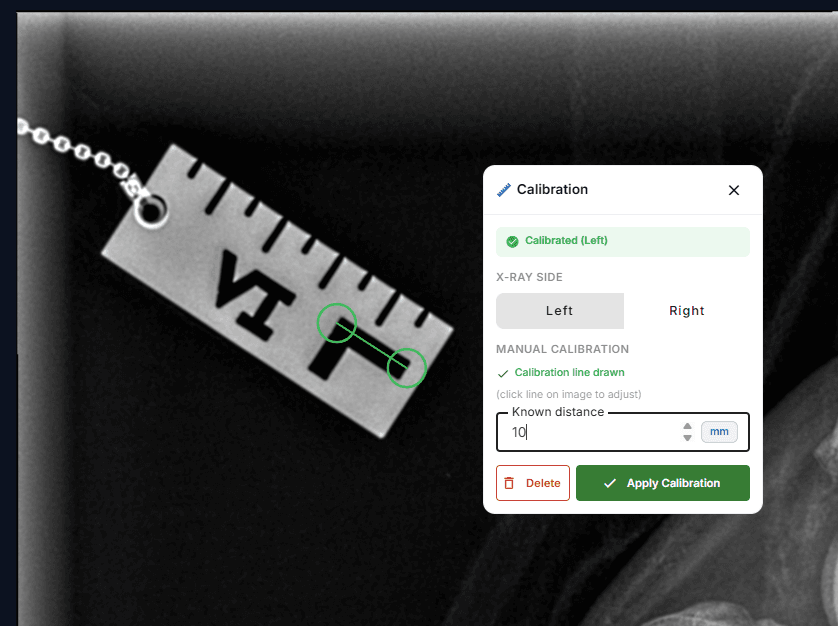
Every millimeter in the plan is derived from calibration. Draw a line across a known distance on the marker (10 mm in the image below) and apply it. Use a marker at the level of the tibia so it is magnified the same amount as the bone. DICOM pixel spacing is a useful cross-check, but it is measured at the detector; the bone sits above the detector and is magnified. See radiograph calibration for TPLO.
Step 2: Measure the TPA from exact geometry
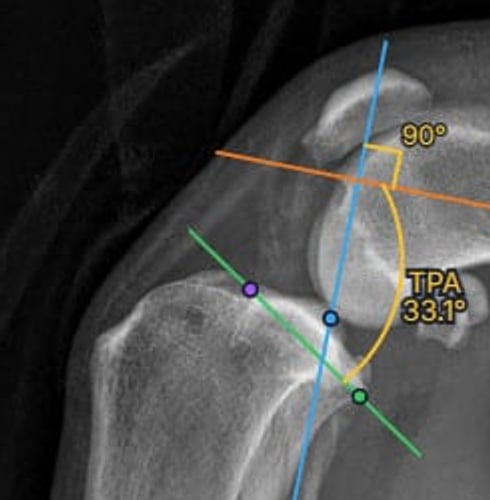
With the four landmarks set, osAlign constructs the functional axis from the intercondylar eminence to the talus, draws the true perpendicular, and measures the plateau angle to 0.1°. You see every line, so you can check the geometry, not just trust a number.
Step 3: Draw the saw cut at true size
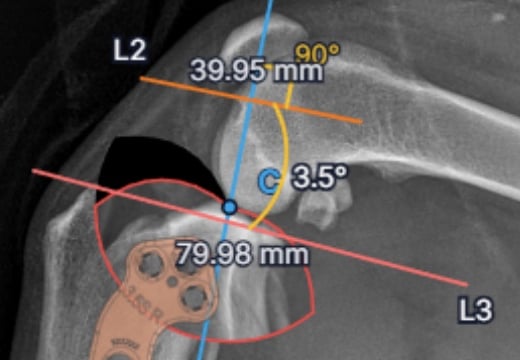
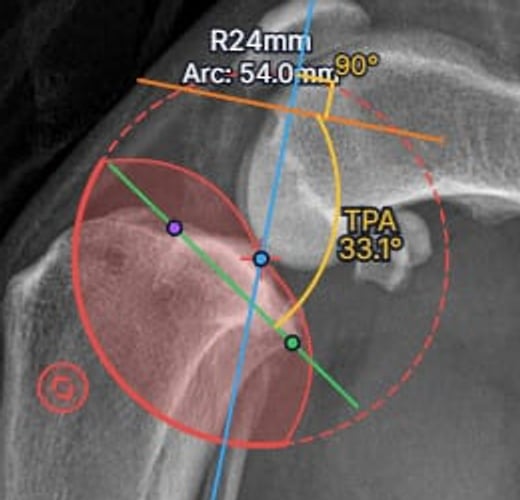
The saw cut tool draws the blade circle at its real radius on the calibrated image, from standard blade sizes between 8 mm and 34 mm. You set the arc length to the millimeter and adjust the curved edges to match the blade, so the planned cut and the tuberosity width left in front of it are the ones you will actually get.
Step 4: Rotate on the image and read the result
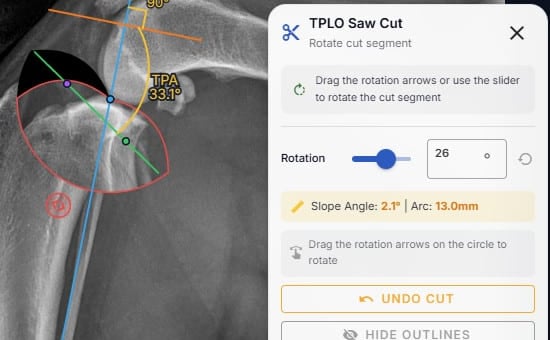
The textbook rotation formula assumes the TPA falls by exactly the angle you rotate. In reality the plateau segment carries the intercondylar eminence with it, so the functional axis shifts slightly as you rotate. Simulating the rotation on the image captures that: osAlign renders the rotated segment and re-measures the slope and the arc length along the cut, to 0.1° and 0.1 mm, at every step. One click also rotates straight to your saved target angle.
Step 5: Template a true-size plate
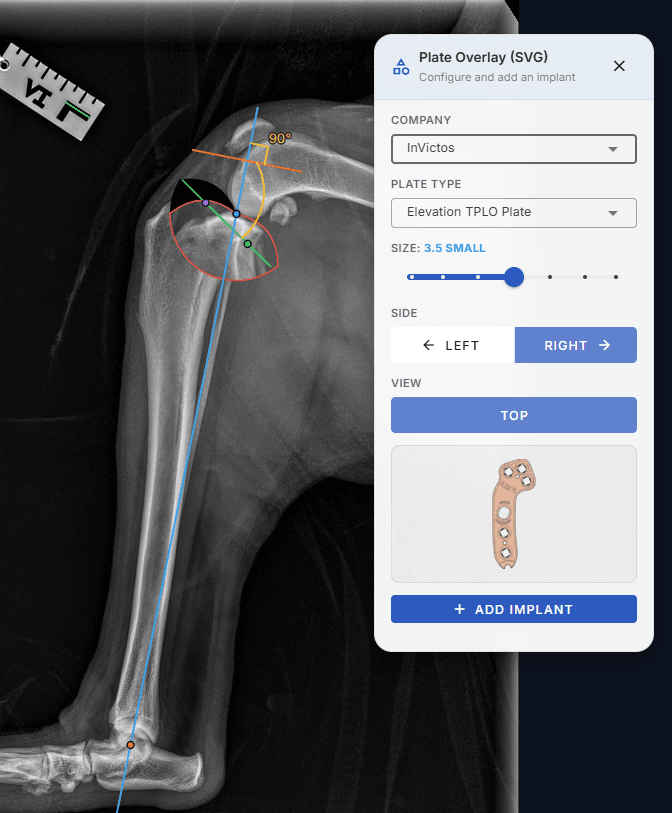
osAlign's plate outlines are built from measured physical plates, not traced catalog drawings, and are drawn at true scale on the calibrated image. Checking that proximal screws clear the joint and the osteotomy is only meaningful if the template is the real size.
Precision versus accuracy: what still limits a plan
Precision is how finely a value is reported. Accuracy is how close it is to the real bone. osAlign removes rounding and chart error, but these factors still decide accuracy:
| Source of error | Effect | How to control it |
|---|---|---|
| Magnification | Bone measures larger than it is | Calibrate on a marker at bone level |
| Oblique or rotated view | Plateau margins shift; TPA can change by several degrees (Reif 2004) | True lateral, condyles superimposed |
| Landmark placement | A few degrees of variation between observers | Zoom in; review AI-placed points |
| Calibration line placement | Scales every length in the plan | Measure the longest known distance available |
| Surgical execution | The plan must be reproduced in theatre | Record rotation and osteotomy distances to mark on the bone |
Frequently asked questions
How precise is osAlign's TPLO planning?
osAlign reports lengths to 0.1 mm and angles to 0.1°, including the TPA, the post-rotation slope, the saw cut arc, and the rotation distance, all on a radiograph you calibrate first.
How many millimeters of rotation is one degree in a TPLO?
It depends on the blade radius: 2π × radius ÷ 360. That is about 0.21 mm per degree for a 12 mm blade, 0.31 mm for 18 mm, 0.42 mm for 24 mm, and 0.52 mm for 30 mm.
Is 0.1 mm precision the same as 0.1 mm accuracy?
No. Precision is the resolution of the measurement. Accuracy also depends on radiograph positioning, magnification, calibration, and landmark placement, which is why osAlign shows the full geometry for the surgeon to verify.
References
- Collins JE, Degner DA, Hauptman JG, DeCamp CE. Benefits of pre- and intraoperative planning for tibial plateau leveling osteotomy. Vet Surg. 2014;43(2):142-149. https://pubmed.ncbi.nlm.nih.gov/24491234/
- Reif U, Dejardin LM, Probst CW, DeCamp CE, Flo GL, Johnson AL. Influence of limb positioning and measurement method on the magnitude of the tibial plateau angle. Vet Surg. 2004;33(4):368-375. https://pubmed.ncbi.nlm.nih.gov/15230840/
- Fox DB. TPLO principles, patient selection, and preoperative planning (rotation distance formula).
- Fettig AA, Rand WM, Sato AF, et al. Observer variability of tibial plateau slope measurement in 40 dogs with cruciate ligament-deficient stifle joints. Vet Surg. 2003;32(5):471-478. https://pubmed.ncbi.nlm.nih.gov/14569576/
- Assessment of the accuracy of digital surgical planning and its implementation with TPLO. Veterinary Research Communications (Springer), 2026. https://link.springer.com/article/10.1007/s11259-026-11253-w
For educational and planning support only. Surgeon judgment governs all clinical decisions.
Related guides
Plan your next TPLO in under 60 seconds
AI places the landmarks, the TPA is calculated instantly, and every measurement is reported to 0.1 mm. 30-day free trial with up to 5 cases, no credit card required.
Start free trial